
Curved-Layer Toolpaths for a Self-Supporting Thin-Shell Column
Description
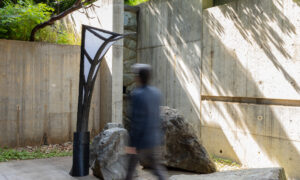
Axisymmetric Column No. 1 is a self-supporting thin-shell column produced by large-scale robotic additive manufacturing, using curved-layer pellet extrusion to deposit short-carbon-fiber PLA onto a pre-stretched textile formwork. Its curved, non-planar toolpaths are generated computationally, so a single algorithm tunes fiber orientation, stiffness, and weight across the shell and builds a self-supporting form that reaches beyond the robot arm’s fixed workspace. The patterning study draws cross-ply and quasi-isotropic layups from composite engineering to control performance across the column.
Program Development
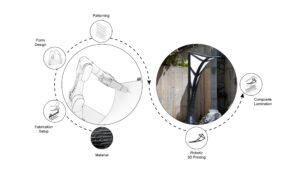
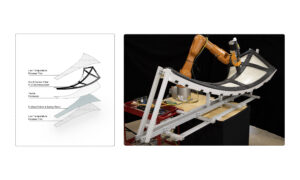

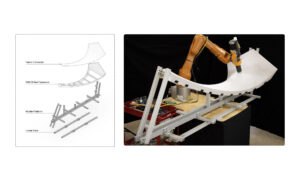
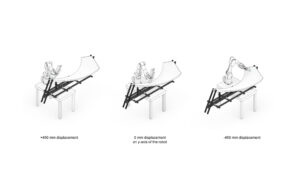
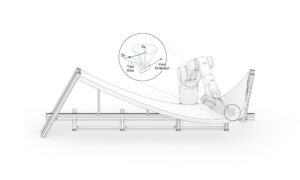
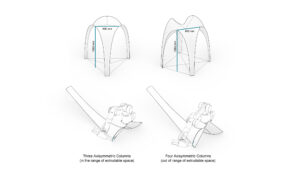
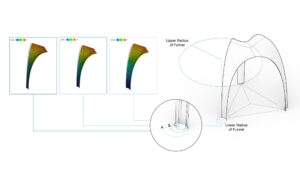
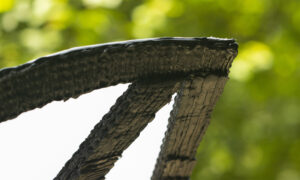
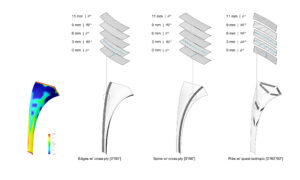
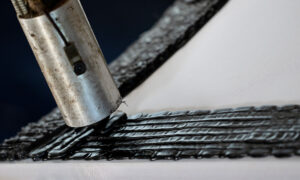
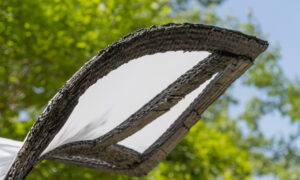
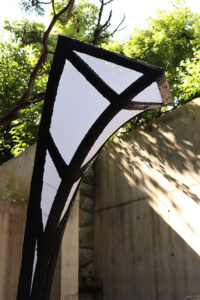
The fiber layup and the curved-layer, non-planar toolpaths were generated parametrically and resolved directly into robot motion, a data-to-toolpath workflow in which a single algorithm tunes stiffness and weight across the shell. Fiber-layup orientation is treated as a controllable design parameter: cross-ply [0°/90°] and quasi-isotropic [0°/60°/90°] patterns, drawn from composite engineering, let the same algorithm adjust performance point by point rather than laying a uniform wall.
The final unit, including the shell structure and the base, has a height of 2300mm with a span of 900mm, and is reinforced by 10 kg of SCF-PLA pellets. The developed nonplanar robotic 3D printing technique was applied to reinforce an individual axisymmetric column, one of three columns in a vault structure.
Full open access Rob|Arch Conference Paper: 3D Printing Pattern Effects on SCF-PLA Extrusion on Pre-stretched Textile Formwork
Venue
Rob|Arch 2024 (thin-shell column), University of Virginia · CT.lab
Role
Designed the computational toolpath system and operated the robotic fabrication
Design Method
Computational Design (Raster Orientation & Curved-Layer Non-Planar Toolpaths), custom Python (and C#) components in Rhino/Grasshopper for data-to-toolpath generation
Fabrication Process
Additive Manufacturing (Large-Scale Polymer Extrusion; Curved-Layer Fused Filament Fabrication, CLFFF)
Building Material
Polymer Composite (SCF-PLA, ~10 kg); Spandex Fabric (nylon & polyester)
Construction System
Hybrid Formwork (pre-stretched textile shell)
Final Dimensions
H 2.3 m × Sp 0.9 m (7 ft 6 in × 3 ft)
Student Research Assistants
Avery Edson, Juliana Jackson, Eli Sobel, and Tabi Summers
Image Credit
Ehsan Baharlou, CT.lab, University of Virginia, 2024